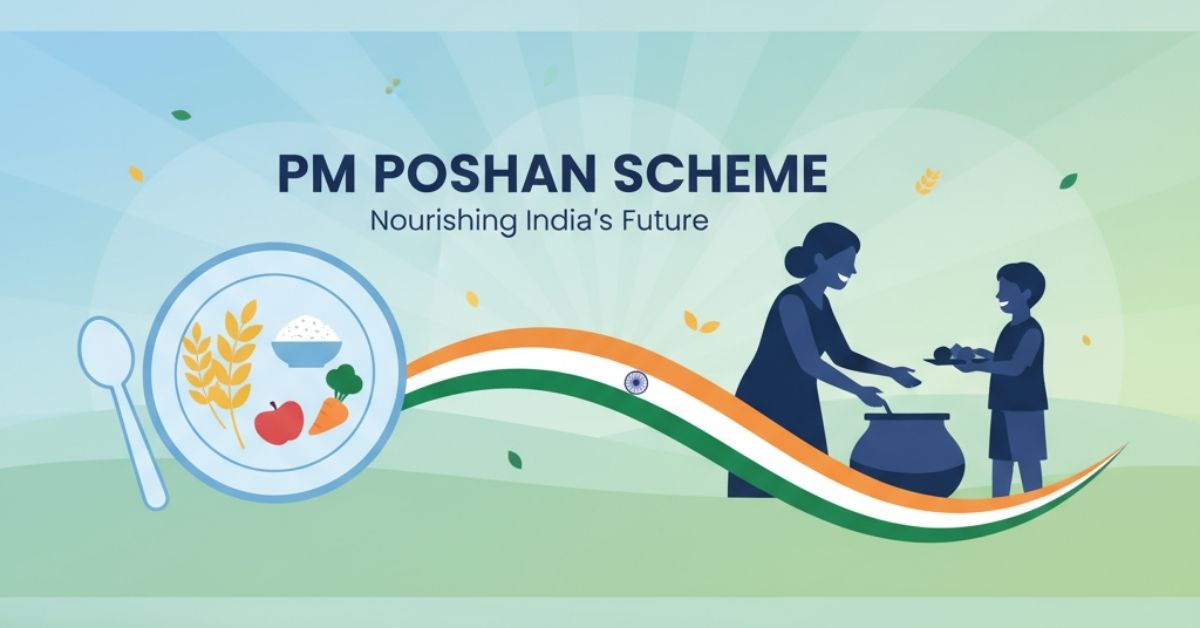
A child’s growth depends on two things: food and education. A hungry child cannot stay attentive in class or plan for a bright future. For millions of Indian schoolchildren, a nutritious meal is more than just food — it is the motivation to go to school, stay healthy, and continue learning without interruption.
To ensure that every child receives both education and proper nutrition, the Government of India launched PM POSHAN (Prime Minister’s Overarching Scheme for Holistic Nourishment). The initiative builds upon and expands the former Mid-Day Meal Scheme, transforming it into a more comprehensive program focused on nutrition, learning outcomes, and holistic child development.
This blog provides a complete overview of PM POSHAN — its purpose, goals, benefits, implementation, impact, challenges, and future roadmap.
🌟 What is PM POSHAN?
PM POSHAN is the Government of India’s flagship school meal program that provides one nutritious cooked meal every school day to children studying in government and government-aided schools.
It covers:
- Children from Class 1 to Class 8
- Children in balvatikas (pre-primary sections) in government schools
The central aim is to ensure that:
- No child remains hungry during school hours
- Every child receives nutritious food for physical and cognitive development
- Children stay in school without dropping out due to hunger or poverty
In simple words:
PM POSHAN = Education + Nutrition + Growth + Attendance + Learning
🎯 Main Objectives of PM POSHAN
PM POSHAN is designed to uplift children and society in multiple ways:
- Provide nutritious meals to children in school
- Improve learning outcomes and classroom performance
- Reduce absenteeism and dropout rates
- Promote social inclusion and equality among students
- Improve health and nutrition indicators such as reducing anemia and malnutrition
- Support women’s self-help groups and local farmers through decentralized food sourcing
👥 Who Is Included Under PM POSHAN?
The scheme benefits:
- Students in Classes 1–8 in government and government-aided schools
- Children in pre-primary classes (balvatikas) in government schools
- Out-of-school children enrolled in special training centers
Every day, millions of children — especially those from low-income families — receive nutrition and educational support through the program.
🥗 What Kind of Food Is Served?
Meals are scientifically planned to meet the calorie, protein, and micronutrient needs of growing children.
A sample meal may include:
- Rice or wheat/chapatis
- Dal or pulses
- Vegetables
- Oil/fats
- Salt and spices
- Eggs, milk, or fruits (depending on state rules)
States often localize the menu based on regional food habits. Examples include:
- Khichdi
- Pongal
- Rajma-rice
- Sambar-rice
- Poha / Upma
- Chapati-sabzi
Many states have now introduced additional nutrition measures:
- Millet-based dishes
- Weekly serving of eggs or milk
- Fortified rice
- Green leafy vegetables
Menus are revised periodically to align with nutritional guidelines.
🔑 Key Features of PM POSHAN
PM POSHAN is not just a meal program — it is a holistic child welfare initiative. Some of its notable features include:
- Hot cooked meals served every school day
- Coverage from pre-primary to Class 8
- Nutritional gardens grown within school campuses
- Tithi Bhojan — community participation for special meals
- Strict hygiene and safety protocols in kitchens
- Social audits and inspections for transparency
- Digital monitoring through school-based records
The government follows strict food quality standards to ensure safe, tasty, and nutritious meals for children.
💰 Funding Pattern
PM POSHAN is a centrally sponsored scheme, meaning funding is shared between:
- Central Government
- State / Union Territory Governments
The Central Government provides:
- Food grains free of cost
- Financial support for cooking ingredients, transportation, and monitoring
🏫 School-Level Implementation
PM POSHAN operates through a complete, step-by-step system within schools:
- Food grains delivered to schools or central kitchens
- Cook-cum-helpers prepare meals
- Meals are served to children during school hours
- Teachers oversee distribution and mealtime discipline
- Schools maintain attendance and meal records
Schools promote:
- Handwashing before meals
- Clean common dining spaces
- Children sitting together irrespective of caste or background
- Avoiding food wastage
🧒 Impact of PM POSHAN on Children and Society
The scheme has created a transformational impact in both rural and urban India:
✔ Higher school attendance
Parents are more motivated to send their children to school when a healthy daily meal is assured.
✔ Better academic performance
Nutrition improves concentration, memory, and participation in class.
✔ Reduced dropout rates
Children — especially those from low-income households — stay enrolled longer.
✔ Health improvement
Many states have reported a decline in malnutrition and anemia rates.
✔ Social equality
Children from all communities sit together and eat the same meal, strengthening social harmony.
✔ Empowerment of women and local economy
Women from SHGs are often employed for cooking and procurement, and ingredients are sourced from local farmers — creating livelihoods in villages.
⚠ Challenges Faced by PM POSHAN
Although the scheme has made remarkable progress, it still faces certain challenges:
- Inadequate kitchen and storage infrastructure in some schools
- Variation in food quality across districts
- Increasing ingredient costs due to inflation
- Shortage of trained helpers and staff
- Difficult logistics in hilly and remote regions
- Delays in fund distribution in certain areas
Digital monitoring, timely funding, and stronger local participation can improve these implementation gaps.
🔮 Future Roadmap for PM POSHAN
As India strengthens its education and health systems, PM POSHAN is evolving into a more nutrition-focused program. Future developments may include:
- Universal millet-based meals for better micro-nutrition
- Weekly mandatory serving of eggs, milk, or fruits in all states
- A nutrition garden in every school
- Real-time digital monitoring through mobile apps
- Growth and nutrition dashboards for every district
- More collaboration with farmer-producer organizations
- Height and weight tracking of children for early detection of malnutrition
The ultimate aim is to ensure that every child receives high-quality nutrition every day in school.
🏁 Final Thoughts
PM POSHAN is much more than a school meal scheme — it is a nation-building initiative. By providing nutritious food to children, the scheme is:
- Strengthening learning outcomes
- Improving children’s health
- Reducing hunger and poverty
- Supporting equality
- Empowering local communities
A well-fed child learns better, dreams bigger, and achieves more. PM POSHAN is helping millions of families who struggle to provide daily nutrition, making schooling more meaningful and inclusive.
Good nutrition is a right, not a luxury. Through PM POSHAN, India is ensuring that no child goes hungry during school hours and every child receives an equal chance at growth, learning, and success.