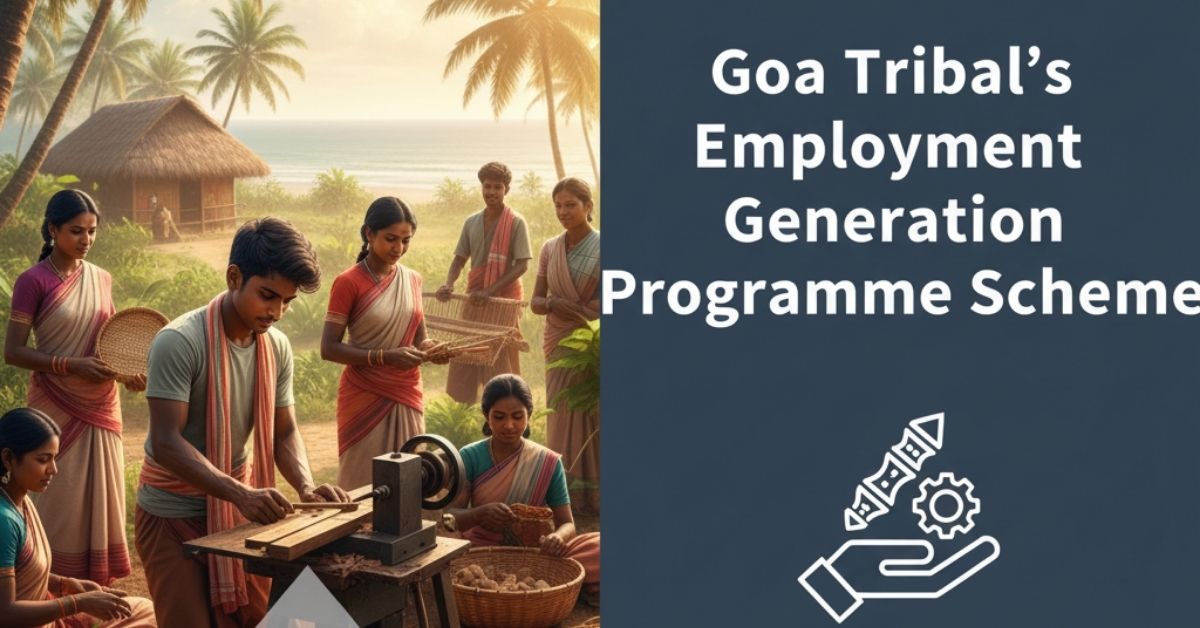
One of the most important things that can help people become more powerful is economic inclusion. Access to meaningful livelihood opportunities can change not only the lives of individuals but also whole generations for communities that have always lived on the edges.
Goa is known around the world for its tourism and culture, but it also has a large Scheduled Tribe (ST) population, many of whom still face socio-economic challenges, limited access to resources and lower participation in mainstream economic activities.
To uplift tribal families and generate sustainable livelihoods, the Government of Goa launched the Goa Tribal’s Employment Generation Programme Scheme (GTEGP) under the supervision of the Goa State Scheduled Tribes Finance and Development Corporation (GSSTFDC).
This initiative enables Scheduled Tribe entrepreneurs to access financial support to start and expand income-generating businesses across the state. It supports traditional occupations, new business ventures and service-based activities — turning self-employment into a path to dignity and growth.
(GSSTFDC – Official Website)
This blog explains the scheme in detail — its goals, benefits, eligibility, documents, sector-wise opportunities, application steps and long-term social impact.
1. Learning About the Goa Tribal’s Employment Generation Programme Scheme
The GTEGP is a flagship programme that supports members of the Scheduled Tribe community to start new businesses or expand existing ones. The scheme provides financial support in the form of bank-linked loans with government subsidy assistance.
The aim is to help ST citizens participate fully in Goa’s economy by launching enterprises in areas such as:
- Manufacturing
- Trading
- Service activities
- Traditional livelihood occupations
The scheme aligns with the state’s larger mission of inclusive and sustainable development, ensuring growth benefits everyone.
(Tribal Welfare – Goa)
2. Why the Scheme Is Necessary
Historically, ST communities in Goa have faced barriers like:
- Lack of capital to start a business
- No collateral for loans
- Low participation in formal financial institutions
- Limited entrepreneurial awareness
- Challenges in marketing traditional crafts and services
As a result, many tribal youths struggle with:
- Underemployment
- Seasonal / informal labour
- Migration for unskilled jobs
The GTEGP addresses these challenges by offering credit support, subsidy and access to bank financing, making entrepreneurship a stable livelihood option rather than a risk.
3. Goals of the Plan
| Goal | What to Expect |
| Encourage self-employment | Reduce dependency on irregular and low-wage labour |
| Improve socio-economic status of tribal families | Enable steady income and financial security |
| Promote entrepreneurship | Support small businesses, services and traditional occupations |
| Reduce migration | Create work opportunities locally |
| Enable inclusive development | Ensure tribal communities benefit from economic growth |
| Increase tribal participation in business | Strengthen representation of ST entrepreneurs |
The aim is not only business creation — but long-term financial stability and empowerment.
4. Who Can Benefit? – Requirements for Eligibility
The scheme is exclusively for Scheduled Tribe residents of Goa.
General Eligibility Conditions
- Must belong to the Scheduled Tribe (ST) category
- Must be 18 years of age or above
- Must be a resident of Goa
- Must plan to start or expand a business
- Must not be a defaulter in any bank or financial institution
The programme encourages participation from:
- Educated unemployed youth
- Skilled workers wanting to start a business
- Women entrepreneurs
- Traditional artisans
- Individuals eager to launch small-scale ventures
5. Financial Help Offered
The GTEGP provides loan assistance through banks along with subsidy from GSSTFDC.
Loan Amount
- Depends on the business proposal and bank appraisal
- Covers capital investment + working capital
Margin Money Subsidy
- Released by GSSTFDC after the loan is sanctioned and disbursed
- Subsidy reduces repayment burden and encourages business confidence
Repayment
- Tenure depends on project viability
- Repayment structured through EMIs
Collateral
- Small-scale projects may qualify for collateral-free financing, based on bank norms
In short, the cost is shared between the entrepreneur, bank and government subsidy, making self-employment more accessible.
6. Types of Businesses Covered Under the Plan
The scheme supports diverse livelihood activities, covering rural, semi-urban and entrepreneurial aspirations.
6.1 Manufacturing / Production
- Cashew and spice processing
- Candle making
- Organic farm produce units
- Traditional food products
- Carpentry and furniture making
- Handicraft production
6.2 Service Sector
- Vehicle repair garages
- Beauty salons and grooming units
- Tailoring and embroidery shops
- Mobile / electronics repair centres
- Coaching and tuition centres
- Fitness and wellness services
6.3 Trading and Retail
- Grocery and general stores
- Clothing and textile shops
- Hardware and household item stores
- Agricultural supply shops
6.4 Tourism-Linked Opportunities
- Bicycle / two-wheeler rental
- Local tour guiding
- Homestays / guesthouses
- Traditional snack and food counters
6.5 Traditional Livelihoods
- Bamboo and woodcraft
- Coir products
- Fishing activities in tribal regions
- Folk arts and cultural event activities
- Tribal jewellery and craftwork
The range of opportunities shows the scheme’s inclusive approach to traditional and modern livelihood models.
7. Documents Required
Applicants typically need:
- Application form (as per GSSTFDC guidelines)
- Aadhaar Card
- ST Caste Certificate
- Residence Certificate
- Age Proof (Birth Certificate / School Leaving Certificate)
- Bank Account Passbook
- Passport-size photographs
- Business proposal / project report
- Skill certificates (if applicable)
Banks may request additional documents during appraisal.
8. Step-by-Step Process for Applying
- Develop a business idea and project report
Estimate costs and define the business model. - Get the application form
Available from GSSTFDC offices or notified centres.
(Download forms – GSSTFDC) - Attach the required documents
Include ID proof, caste certificate, banking details and project report. - Submit application to GSSTFDC / Bank
For processing and preliminary checks. - Bank appraisal
Bank evaluates feasibility and repayment capability. - Loan sanction and disbursement
Funds are transferred directly to the entrepreneur. - Release of subsidy
GSSTFDC releases subsidy after the business is operational.
This ensures responsible financing and transparent monitoring.
9. Good Things About the Scheme
For Individuals
- Access to affordable credit
- Start or expand a business
- Financial independence and dignity
- Better quality of life for families
For the Community
- More employment within tribal areas
- Preservation of cultural skills through monetisation
- Reduced economic inequality
For the State
- Growth of micro-enterprises
- Stronger rural and semi-urban economy
- Diversification beyond tourism
The scheme contributes to inclusive and balanced development across Goa.
10. Long-Term Effects on Society and the Economy
| Impact Area | Contribution |
| Economic | Higher income & improved savings |
| Social | Confidence and dignity for ST entrepreneurs |
| Cultural | Protection of traditional skills and heritage |
| Women Empowerment | More tribal women entering business |
| Rural Development | Reduced migration due to local jobs |
| MSME Ecosystem | More micro-entrepreneurs and local production |
Entrepreneurship becomes not just an income source, but also a tool of empowerment and progress.
11. Problems to Face and Opportunities for the Future
| Challenge | Suggested Path |
| Low awareness in remote areas | Stronger grassroots outreach |
| Digital and financial literacy gaps | Training and handholding support |
| Weak market linkages | Support for branding, e-commerce and exhibitions |
| Fear of taking loans | Counselling and success-story promotion |
Future expansion opportunities include:
- Support for digital entrepreneurship
- Special incentives for women-led tribal enterprises
- Export-linked skill and production support
- Cluster development for traditional crafts and agro-based industries
Final Thoughts
The Goa Tribal’s Employment Generation Programme Scheme is not just a financial programme — it is a social transformation movement. By encouraging entrepreneurship among Scheduled Tribe communities, it empowers individuals to:
- Build stable income
- Preserve cultural heritage
- Reduce dependence on seasonal labour
- Create employment within their own communities
Through this scheme, the Government of Goa is ensuring that tribal communities move from the margins to the centre of economic development — through opportunity, dignity and self-reliance.
A strong economy is one where every community can participate and prosper.
The GTEGP is a powerful step toward that future.