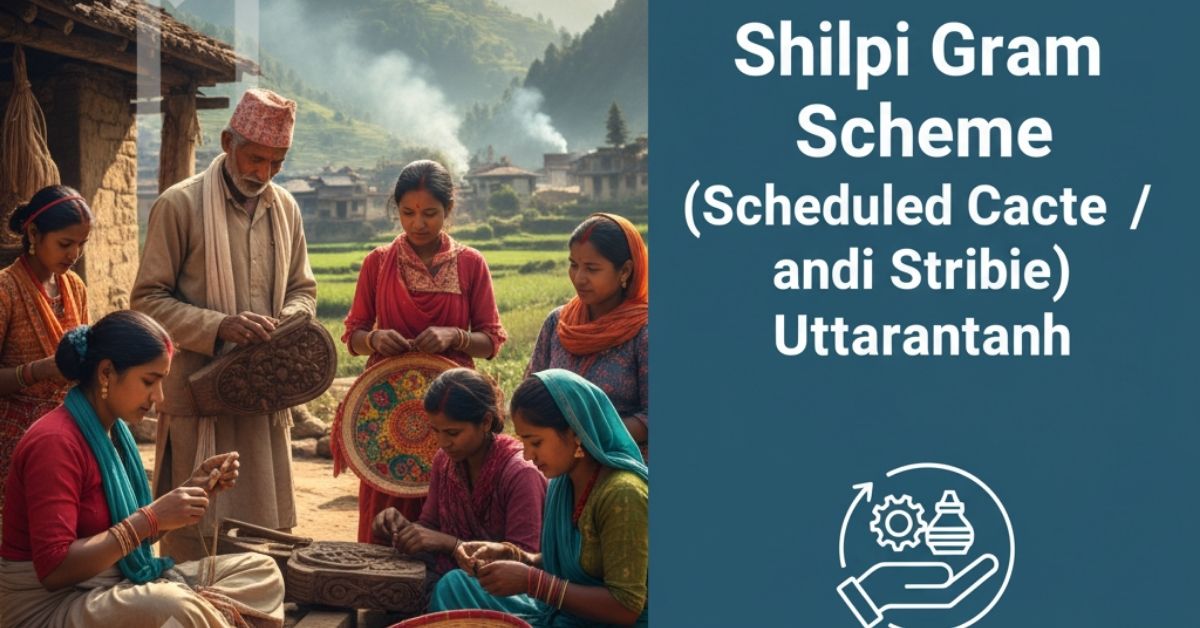
Traditional art, craft, music and handloom work have always been integral to Uttarakhand’s cultural identity. For centuries, artisans—known as “Shilpis”—have kept heritage alive through wood carving, metalwork, bamboo craft, painting, weaving and stone craftsmanship.
But despite contributing immensely to cultural preservation, many of these artists belong to Scheduled Caste (SC) and Scheduled Tribe (ST) communities that face poverty, social discrimination and lack of access to modern opportunities.
To uplift these communities, the Government of Uttarakhand launched the Shilpi Gram Scheme (SC/ST) — an initiative that provides financial assistance, skill development opportunities and market access to artisans so they can build sustainable livelihoods with dignity.
🔗 (Reference: Social Welfare & Tribal Welfare Department, Govt. of Uttarakhand — https://socialwelfare.uk.gov.in/)
This article explains the scheme in detail — including its goals, benefits, eligibility criteria, the application process and its long-term impact on empowerment.
1. Learning About the Shilpi Gram Scheme
The Shilpi Gram Scheme (Scheduled Caste/Scheduled Tribe) is a welfare initiative aimed at strengthening SC/ST artisans involved in traditional crafts of Uttarakhand.
Under the scheme, artisans are supported through:
✔ Community craft workspaces called Shilpi Grams
✔ Financial support for tools, machinery and raw materials
✔ Training and capacity-building workshops
✔ Support for exhibitions and fairs to expand market reach
✔ Encouragement for self-employment and entrepreneurship
The mission behind the scheme can be summarized as:
“Empower the artisan, and the culture will preserve itself.”
2. Why the Scheme Was Needed
Although Uttarakhand’s cultural heritage is rich, SC/ST artisans face several barriers:
2.1 Low Pay and Exploitation
Middlemen buy traditional handicrafts at very low prices and resell them at high margins, leaving artisans underpaid.
2.2 Migration and Job Loss
Due to income uncertainty, many artisans abandon their craft and move to cities for unskilled labour jobs.
2.3 Lack of Skill Upgradation
Art and fashion markets evolve quickly, but many artisans lack training in modern techniques, digital marketing and consumer trends.
2.4 Little Branding or Marketing Support
High-quality handmade products often remain unsold due to poor packaging and online absence.
2.5 Socio-Economic Disadvantages
Being from SC/ST communities increases barriers to education, resources and recognition.
The Shilpi Gram Scheme addresses these issues by providing tools, training and financial support — breaking the cycle of poverty for artisans.
3. Main Goals of the Shilpi Gram Scheme
| Goal | Purpose |
| Support traditional arts | Preserve Uttarakhand’s heritage crafts |
| Promote employment | Create sustainable livelihood opportunities |
| Strengthen SC/ST communities | Reduce socio-economic inequality |
| Encourage entrepreneurship | Help artisans become self-reliant |
| Improve market access | Boost sales through fairs, exhibitions and online platforms |
| Enhance skills | Provide design, business and technical training |
4. Important Benefits of the Shilpi Gram Scheme
The scheme provides a wide range of benefits to eligible artisans.
4.1 Financial Support
- Support for purchasing raw materials, equipment and tools
- Assistance for setting up workshops and workstations
4.2 Common Workspace (Shilpi Grams)
- Shared creative hubs for artisans to:
- Work collaboratively
- Use shared tools and machinery
- Take part in skill development activities
4.3 Training & Capacity Building
Workshops conducted by the government and partner organisations include:
- Skill enhancement and design innovation
- Business and entrepreneurship development
- Digital marketing and e-commerce lessons
4.4 Sales & Marketing Support
Opportunities for artisans to:
- Showcase products at state, national and international exhibitions
- Sell through craft fairs and online platforms
- Receive branding and packaging support
4.5 Focus on Women Empowerment
Special support encourages women artisans to gain financial independence through traditional craft occupations.
5. Crafts Covered Under the Scheme
The scheme supports a wide range of art and craft forms, including:
- Wood and stone carving
- Ringal (bamboo) craft
- Copper and metal craft
- Handloom and wool weaving
- Terracotta and pottery
- Painting and murals
- Embroidery and handcrafted ornaments
Artisans involved full-time or part-time are encouraged to apply.
6. Eligibility Criteria
To qualify for the Shilpi Gram Scheme (SC/ST) Uttarakhand:
- Must be a resident of Uttarakhand
- Must belong to SC or ST category
- Must be engaged in traditional craft, art, sculpture or similar activity
- Must be 18 years or older
- Proof of artisan profession may be required (work samples, certificate, local verification etc.)
7. Documents Required
Documents normally required (can vary by district):
- Aadhaar Card
- Uttarakhand Domicile Certificate
- SC/ST Caste Certificate
- Passport-size photographs
- ID proof (Voter ID/Driving Licence etc.)
- Bank passbook copy
- Proof of artisan profession (certificate / images of work / membership in craft association)
8. How to Apply (Step-by-Step)
Applications can be submitted through the Social Welfare Department or Tribal Welfare Department of Uttarakhand.
Step 1: Collect the Application Form
- Available at District Social Welfare Office / Tribal Welfare Office
- In some districts, forms may be available online
🔗 Govt Portal: https://socialwelfare.uk.gov.in/
Step 2: Fill in Personal & Craft Details
- Name, caste, craft category, experience, bank details, etc.
Step 3: Attach Supporting Documents
- Aadhaar, caste certificate, bank passbook, proof of artisan work etc.
Step 4: Submit the Application
Submit to:
- District Social Welfare Officer
- Block Office
- Artisan / Craft Welfare Centre (if applicable)
Step 5: Verification
Authorities verify:
- Identity
- Caste category
- Artisan craft profession
- Eligibility for financial/skill benefits
Step 6: Receiving Benefits
If approved, artisans receive:
- Financial assistance
- Access to Shilpi Gram workspaces
- Training and business/marketing support
9. Long-Term Effects on Empowerment
The Shilpi Gram Scheme empowers SC/ST artisans on three levels:
🌱 Economic Empowerment
- Stable income from craft-based livelihood
- Reduced dependence on middlemen
- Scope for global e-commerce sales
🤝 Social Empowerment
- Recognition as skilled professionals
- Improved dignity and living standards
- Reduced social marginalisation
🎨 Cultural Empowerment
- Promotion and revival of traditional crafts
- Encouragement for youth to continue ancestral crafts
- Preservation of Uttarakhand’s creative heritage
10. Challenges and the Way Forward
| Challenges | Suggested Solutions |
| Low awareness | Local campaigns & digital outreach |
| Delay in funds | Faster digital grievance redressal |
| Limited marketing | Govt-supported e-commerce marketplace |
| Export barriers | Partnerships with global craft platforms |
| Youth migration | Higher incentives for young artisans |
If these improvements are implemented consistently, the scheme can transform thousands of lives.
11. Why the Scheme Truly Matters
The Shilpi Gram Scheme is not just a financial assistance programme. It is:
- Respect for tradition
- Restoration of pride in craftsmanship
- Economic independence for marginalised communities
A government plan becomes powerful not when it only provides funds, but when it builds self-confidence, skill and sustainable livelihood — and that is exactly what this scheme does.
Final Thoughts
The Shilpi Gram Scheme (Scheduled Caste / Scheduled Tribe) Uttarakhand is a groundbreaking initiative blending culture, livelihood and social justice. By providing financial support, workspaces, skills and market access, the scheme gives SC/ST artisans the foundation to build secure, self-sufficient and dignified futures.
If Uttarakhand’s arts continue to flourish, it won’t just be because the craft survived —
it will be because the artisan was empowered.
Last Thought
Progress isn’t just when a craft is displayed in a museum —
it’s when the artisan who created it feels proud, valued and financially secure.