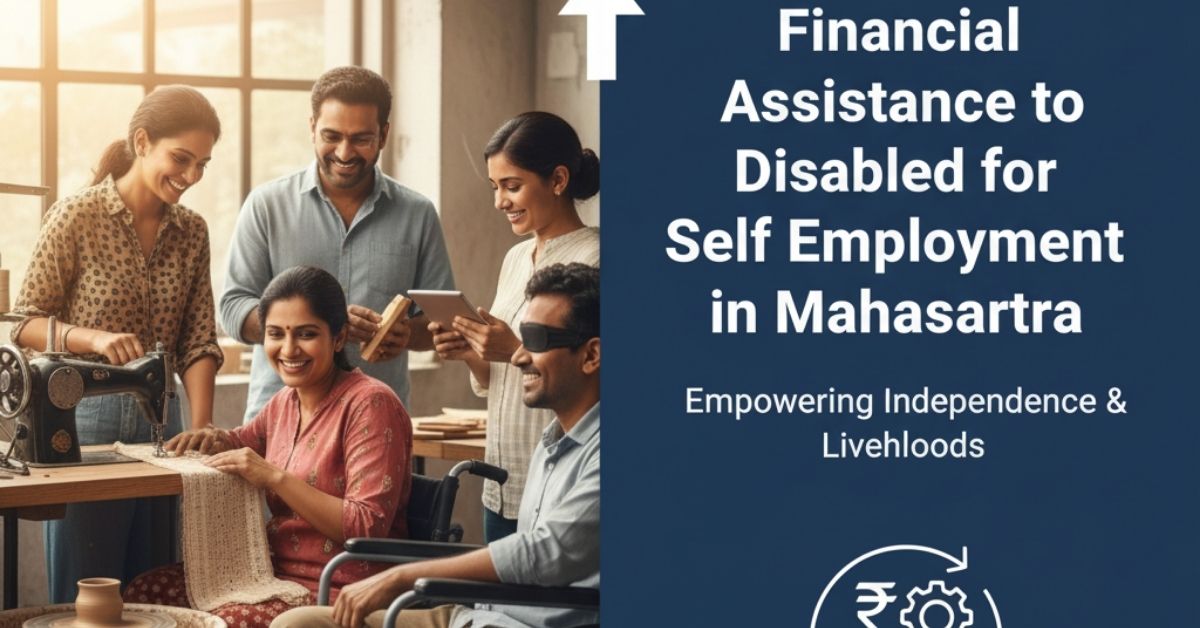
People with disabilities (PwDs) in India face many problems, not just physical ones. These problems include social, economic, and job-related issues. Many of them have talent, skills, and the desire to work, but they can’t get the money or structured help they need to start their own business.
The Government of Maharashtra has started the “Financial Assistance to Disabled for Self-Employment” programme to fill this gap. The goal of this welfare programme is to help people with disabilities become independent through self-employment, small businesses, and farming.
The programme is run by the Department of Social Justice and Special Assistance, Government of Maharashtra. More information can be found on:
- The state’s official Divyang (Disability) Welfare Portal:
👉 https://divyangkalyan.maharashtra.gov.in - The central myScheme portal:
👉 https://www.myscheme.gov.in/schemes/fadse
🔗 Official scheme page:
Financial Assistance to Disabled Person for Self-Employment
In this blog, we’ll talk about:
- The scheme’s goals
- Who can apply
- Benefits and financial pattern
- Eligible activities
- Documents needed
- Step-by-step application process
- Effects, problems, and future possibilities
- Questions and Answers
💡 What Is the Programme “Financial Assistance to Disabled for Self-Employment”?
The Maharashtra state-funded programme called Financial Assistance to Disabled for Self-Employment gives up to ₹1,50,000 to people with disabilities who want to start or grow their own business.
🔗 Official scheme page:
https://divyangkalyan.maharashtra.gov.in/scheme/financial-assistance-to-disabled-person-for-self-employment/
The money comes in two parts:
- 80% – loan from a nationalised bank
- 20% (up to ₹30,000) – grant (subsidy) from the Social Welfare Department
You can use this help for:
- Starting your own business
- Small businesses
- Projects based on agriculture
The main goal is to help people with disabilities who are unemployed start their own businesses and build a stable income source with dignity.
🎯 Goals of the Plan
The plan has a number of social and economic goals:
✔ Encourage PwDs to Work for Themselves
Give people with disabilities the chance to start small businesses, units, or services instead of relying only on family support or wage work.
✔ Support Small Businesses and Farms
Help small businesses like:
- Small shops
- Service centres
- Repair shops
- Dairies and poultry farms
- Other farming-related activities
✔ Lower Poverty and Financial Dependence
Give money to people with disabilities and their families so they can be financially stable in the long term.
✔ Empowerment and Social Inclusion
Being self-employed can help you:
- Feel more confident
- Gain respect from others
- Become part of the mainstream economy
✔ Help People with All Types of Disabilities
According to the most recent government notices, people with disabilities who are covered by the Rights of Persons with Disabilities Act, 2016, can get benefits in 21 different disability categories.
👥 Who Can Apply? (Eligibility Requirements)
According to official rules, the applicant must meet the following requirements:
- Disability Percentage
The applicant must have at least 40% disability, as certified by a qualified medical professional. - Domicile
You must be a permanent resident of Maharashtra. - Age Limit
You must be between 18 and 50 years old when you apply. - Income Limit
The family’s yearly income should be less than ₹1,00,000. - Unemployed or Underemployed
The programme is mainly for disabled people who are unemployed and want to start their own business. - Beneficiary Category
This includes:- People who are blind
- People with low vision
- People who are deaf or hard of hearing
- People with orthopaedic disabilities
- People with intellectual disabilities
- Other groups as defined by the RPwD Act 2016
- How to Apply
Your application must be sent in the right format to:- District Social Welfare Officer, Zilla Parishad, or
- Assistant Commissioner, Social Welfare Office, Mumbai Urban / Mumbai Suburban
💰 Loan and Subsidy Pattern
The total amount of money that can be given through this programme is ₹1,50,000. The structure is:
- 80% of the project cost → Loan from a nationalised bank
- 20% of the project cost → Subsidy from the Social Welfare Department, limited to ₹30,000
Example
If the project costs ₹1,50,000 in total:
- Bank loan (80%) = ₹1,20,000
- Grant from the Social Welfare Department (20%) = ₹30,000
This structure makes it easier for people with disabilities to get loans from banks with government support.
🛠️ Different Types of Self-Employment That Are Allowed
The programme is flexible and can help with many types of self-employment or small businesses, like:
🛍️ Small Stores and Retail
- Grocery store (Kirana)
- Stationery store
- Mobile phone recharge and accessories store
- General provision store
🧵 Service-Based Units
- Tailoring shop
- Mobile and electronics repair
- Photocopy and computer typing centre
- Beauty salon or parlour (with easy access)
🚜 Agricultural Activities
- Units for dairy and poultry
- Raising goats
- Selling small amounts of vegetables or fruits
- Processing agricultural products like papad, pickles, and spices
🏠 Home-Based and Micro Businesses
- Handicrafts and handmade goods
- Agarbatti or candle making
- Food processing (snacks, tiffin service)
The project should be doable, income-generating, and suited to the applicant’s abilities and local market conditions.
📄 Required Documents
Most of the time, applicants need to submit:
- A properly filled out application form (in the right format)
- Disability certificate (40% or more)
- Domicile certificate (Maharashtra)
- Proof of age (birth certificate, school leaving certificate, or Aadhaar)
- Proof of identity (Aadhaar, Voter ID, or PAN)
- Proof of address (Ration Card, Electricity Bill, or Aadhaar)
- Income certificate (showing annual income below ₹1,00,000)
- Passport-size photographs
- Bank passbook or account information
- Business proposal or project report with estimated cost
- Any information about previous loans or grants, if applicable
For the most up-to-date list of documents, always check the latest notice from the District Social Welfare Office.
Official scheme page (for reference):
👉 https://divyangkalyan.maharashtra.gov.in/scheme/financial-assistance-to-disabled-person-for-self-employment/
✍ How to Apply: Step-by-Step Guide
1️⃣ Check If You Qualify and Read About the Scheme
To get the most up-to-date information, visit:
- Maharashtra Divyang Welfare Portal
👉 https://divyangkalyan.maharashtra.gov.in/ - Social Justice and Special Assistance (District Example: Thane)
👉 https://thane.nic.in/en/social-justice-and-special-assistance-department/ - myScheme Portal (Scheme Summary)
👉 https://www.myscheme.gov.in/schemes/fadse
2️⃣ Write a Simple Business Proposal
Your proposal should include:
- The kind of business you want to start
- Estimated cost (equipment, stock, setup)
- Expected monthly income
- Location of the business
It doesn’t have to be very technical, but it should be clear and realistic.
3️⃣ Get the Application Form
You can usually get forms from:
- District Social Welfare Office (Zilla Parishad)
- Assistant Commissioner, Social Welfare Office, Mumbai Urban/Suburban
- Sometimes through official websites or special camps
4️⃣ Fill Out and Attach Documents
- Fill out the form completely
- Attach all the necessary documents
- Make sure your income and disability certificates are current and valid
5️⃣ Submit to the Right Office
Send the application to:
- District Social Welfare Officer, Zilla Parishad, or
- Assistant Commissioner, Social Welfare Office, Mumbai Urban / Suburban
After checking, they will send the proposal to the concerned nationalised bank.
6️⃣ Bank Processing and Sanction
- The bank reviews your proposal
- If approved, the loan (80%) is sanctioned and the subsidy (20%) is processed by the Social Welfare Department
7️⃣ Begin Your Self-Employment Work
Once the money is given out:
- Buy tools, equipment, and stock as planned
- Start operating your business and maintain basic records
- Make sure you pay back the loan on time to keep your credit score good
🌍 How the Scheme Affects Maharashtra
The plan has had a good effect in many ways:
- People with disabilities are becoming independent earners instead of just being seen as dependents
- Families are getting more money each month and feeling more secure financially
- Many beneficiaries in rural and semi-urban areas have started small shops and businesses
- People’s attitudes towards disabilities slowly change when they see disabled entrepreneurs running businesses confidently
- The scheme works well with other disability programmes like pensions, aids & appliances, and vocational training
⚠ Problems and Difficulties
This programme, like many others that help people, also has some problems with implementation:
1️⃣ Gaps in Knowledge
A lot of PwDs and families who qualify don’t even know that this programme exists.
👉 Solution:
Awareness through Gram Panchayats, NGOs, disability groups, and social media.
2️⃣ Problems with Paperwork and Procedures
It can be hard to get income and disability certificates and write project reports.
👉 Solution:
Setting up help desks, camps, and NGO support to help people fill out forms and prepare documents.
3️⃣ Delays at the Bank Level
Sometimes, banks take a long time to approve loans because they have to follow their own rules and check for risks.
👉 Solution:
Better communication between the Social Welfare Department and banks, as well as clear timelines.
4️⃣ Help After the Loan
Some people who get help need to know how to run the business.
👉 Solution:
Give basic training in entrepreneurship and money management along with the plan.
🔮 Future Scope and Ideas
Maharashtra can make this scheme even more effective in the future by:
- Connecting it to skill development programmes
- Making it easier to apply online
- Getting NGOs and disabled people’s organisations (DPOs) to help with project planning
- Working with other programmes like Mudra loans, marketing support, and e-commerce platforms
- Providing mentorship programmes in which experienced business owners help new self-employed PwDs
⭐ Final Thoughts
The Financial Assistance to Disabled for Self-Employment in Maharashtra is a strong programme that helps people in need in more ways than just giving them money. It is about:
- Opportunity instead of pity
- Dignity instead of need
- Self-reliance instead of helplessness
The plan gives people with disabilities the chance to start shops, units, services, and agro-based businesses that fit their abilities and the needs of the local market by giving them financial help of up to ₹1.5 lakh through a mix of bank loans and government subsidies.
🔗 Official scheme page (for quick reference):
https://divyangkalyan.maharashtra.gov.in/scheme/financial-assistance-to-disabled-person-for-self-employment/
This programme can change the lives of anyone in Maharashtra who is disabled and wants to be able to take care of themselves.
❓ Questions That Are Frequently Asked (FAQs)
1. What is the “Financial Assistance to Disabled for Self-Employment” programme?
The Maharashtra state government has a programme that gives people with disabilities up to ₹1,50,000 (80% loan and 20% subsidy) to start or grow a small business, self-employment, or an agro-based activity.
2. Who can apply?
- People with at least 40% disability
- People who live in Maharashtra
- Aged between 18 and 50 years
- Family income less than ₹1,00,000 per year
3. How much financial help do they give?
Up to ₹1,50,000, with:
- 80% from a loan by a nationalised bank
- 20% (up to ₹30,000) from a subsidy by the Social Welfare Department
4. Where can I find out more or apply?
You can get in touch with:
- District Social Welfare Officer, Zilla Parishad
- Assistant Commissioner, Social Welfare Office (Mumbai Urban/Suburban)
And visit:
👉 https://divyangkalyan.maharashtra.gov.in/scheme/financial-assistance-to-disabled-person-for-self-employment/
5. Is it possible to apply online?
Right now, most applications are processed through district offices using set forms. You can still keep track of scheme details through the myScheme portal: