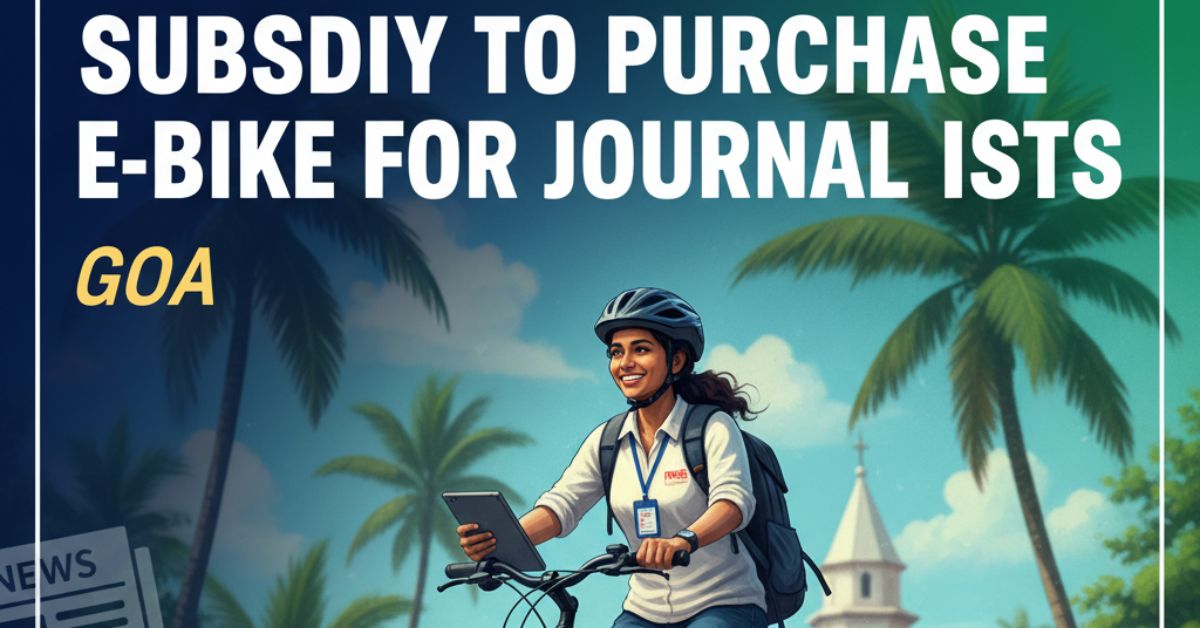
Goa is well-known for its ever-changing social, cultural, and political landscape. Journalism is very important for keeping track of events, increasing public awareness, and ensuring transparency in governance. To support journalists who struggle to gather information across both urban and rural areas, the Government of Goa introduced a subsidy program for journalists to purchase e-bikes. This initiative is a smart combination of press empowerment, environmental protection, and mobility support.
Journalists often need to travel quickly to attend press conferences, conduct interviews, cover local events, and reach remote locations. The subsidy makes transportation more affordable, safer, and eco-friendly, ensuring journalists do not face limitations due to fuel costs or mobility issues.
This article explains the scheme in detail — including its purpose, benefits, eligibility, application procedure, impact, and how it supports both journalism and sustainable development in Goa.
Why Journalists Need Help with Transportation
Before exploring the scheme, it’s important to understand why mobility support matters.
Unlike many professions where the workplace is fixed, journalism is field-oriented. Reporters may need to cover multiple events in different locations on the same day — often in areas with limited public transport. Journalism work also continues beyond regular business hours, such as late evenings, early mornings, weekends, and holidays.
Common mobility challenges faced by journalists include:
- High and fluctuating fuel prices
- Wear and tear of personal vehicles due to constant field travel
- Lack of safe transportation late at night or early morning
- Environmental concerns caused by fuel-based vehicles
The subsidy for e-bikes tackles these issues by providing journalists an affordable and sustainable mode of transportation.
Goals of the E-Bike Subsidy for Journalists
The Government of Goa designed this program with the following objectives:
✔ Improve journalists’ mobility and field efficiency
Fast and affordable transportation helps journalists reach destinations quickly and cover news more effectively.
✔ Reduce financial stress on media professionals
A large share of journalists’ income is often spent on fuel and maintenance. The subsidy helps reduce these expenses.
✔ Promote environmentally friendly transportation
Encouraging electric vehicles supports Goa’s environmental and climate goals.
✔ Support independent and grassroots journalism
Better mobility strengthens reporting not only in urban areas but also in rural and interior villages.
✔ Ensure safety during field assignments
E-bikes offer a secure mode of travel for late-night and emergency reporting.
These goals show that the scheme is an investment in both journalistic freedom and sustainable development.
Key Features of the E-Bike Subsidy Program
| Feature | Description |
|---|---|
| Subsidy assistance | Direct financial support to purchase an electric two-wheeler |
| Eligible vehicle types | Approved and registered electric two-wheelers in Goa |
| Eligible beneficiaries | Accredited journalists working in Goa |
| Application mode | Online or offline depending on official guidelines |
| One-time benefit | Usually provided once per eligible journalist |
The financial subsidy combined with lower running and maintenance costs of electric vehicles provides long-term economic relief.
Why Journalists Should Use E-Bikes
The scheme promotes e-bikes because electric two-wheelers offer advantages ideal for journalists:
🟢 Low operating cost – Charging an e-bike is much cheaper than refilling fuel.
🟢 Low maintenance cost – Fewer moving parts reduce repair expenses.
🟢 Eco-friendly transportation – Zero emissions reduce air pollution and carbon footprint.
🟢 Perfect for Goan roads – Suitable for both coastal routes and city traffic.
🟢 Quiet and smooth travel – Ideal for late-night reporting or hospital visits.
Beyond practicality, journalists using electric vehicles set a visible example of climate-conscious behaviour, encouraging the public to adopt sustainable transport.
General Eligibility Criteria
Eligibility may vary slightly based on updates to the scheme, but generally the applicant must:
- Be a Goan journalist accredited by the Directorate of Information and Publicity or another authorised body
- Work in print, electronic, or digital media (full-time or part-time)
- Provide proof of professional journalism activity in Goa
- Purchase the e-bike for personal and professional journalistic use
- Submit all required documents by the official deadline
Commonly Required Documents
Journalists typically need to submit:
- Accreditation card or certificate
- Identity proof
- Address proof
- Employment proof (letter, ID card, or contract)
- Bank details for subsidy transfer
- Pro-forma invoice / quotation of the e-bike
- Declaration stating the vehicle will be used for journalism purposes
The subsidy is released after document verification and final approval.
Application Procedure
Although exact guidelines may vary, this is the general process:
1️⃣ Check the official notification
Refer to the Government of Goa announcement for updated rules and deadlines.
2️⃣ Prepare necessary documents
ID proof, journalist accreditation, e-bike quotation, etc.
3️⃣ Submit the application
Either online or offline based on the government’s instructions.
4️⃣ Verification of eligibility
Authorities examine the authenticity of documents and accreditation status.
5️⃣ Approval and subsidy release
Once approved, the subsidy amount is released according to scheme rules.
This process ensures transparency and fairness in distributing benefits.
Impact of the Scheme on Journalism in Goa
Although financially simple, the subsidy has significant positive effects:
🔹 More field coverage – Journalists can reach remote locations easily.
🔹 Reduced financial burden – Fuel and repair savings allow focus on reporting.
🔹 Boost to digital and independent journalism – Supports freelancers, bloggers, and rural correspondents.
🔹 Gender inclusion – Women journalists benefit from safe and independent mobility.
🔹 Environmental responsibility – Encourages a shift toward clean mobility.
🔹 Press empowerment – Enhances mobility in a democratic media ecosystem.
Problems and Opportunities Ahead
| Challenge | Suggested Solution |
|---|---|
| Limited awareness | Strengthen outreach through journalist associations |
| Lack of charging stations | Expand EV charging networks across the state |
| Rural participation gap | Establish support desks for applicants in remote areas |
| Upfront bike price | Explore direct billing models with dealerships |
| Battery replacement cost | Provide extra warranty or additional subsidy assistance |
Recommendations to Maximise Success
To strengthen the scheme further:
- Organise awareness campaigns via media houses and journalist unions
- Extend benefit to photojournalists, video creators, and citizen reporters
- Enable zero-down-payment purchase with subsidy integrated at dealership
- Conduct EV maintenance and road safety workshops
- Provide insurance support for field reporters
- Encourage media sponsorships and mobility partnerships
These efforts could help turn the scheme into a complete mobility empowerment program for journalists.
Future Outlook
The subsidy initiative aligns with Goa’s larger goals:
- Increased adoption of sustainable mobility
- Better efficiency in media operations
- Decentralisation of journalism beyond cities
- Encouragement of independent field reporting
- Improved safety and welfare for press personnel
With growing participation, Goa could become a national model for green press mobility, inspiring similar policies across India.
Final Thoughts
The subsidy to purchase e-bikes for journalists in Goa is more than financial assistance — it is an investment in quality journalism, environmental sustainability, and public welfare. By supporting transport needs, the government enables reporters to focus on meaningful journalism without worrying about high fuel expenses or lack of mobility.
This scheme delivers four major benefits:
- Professional empowerment for journalists
- Strengthening of democracy through a mobile free press
- Promotion of green transportation
- Equal opportunities for both urban and rural reporters
In a fast-changing media world, every initiative that strengthens journalism strengthens society. The e-bike subsidy stands as a strong step toward freedom, affordability, sustainability, and respect for Goa’s storytellers.
Frequently Asked Questions (FAQs)
1. Why do journalists in Goa receive a subsidy to purchase e-bikes?
To support mobility, reduce expenses, and promote eco-friendly transportation.
2. Who can apply?
Accredited journalists working in Goa across print, electronic, and digital media.
3. Can freelance journalists apply?
Yes — if they hold valid accreditation and meet the scheme requirements.
4. Does the subsidy cover any electric bike?
It applies to approved and registered electric two-wheelers in Goa.
5. How can journalists apply for the subsidy?
Through the government’s notified application procedure, either online or offline.